
Our Capacity to Survive Our Brokenness
When Broken Is Where You Start
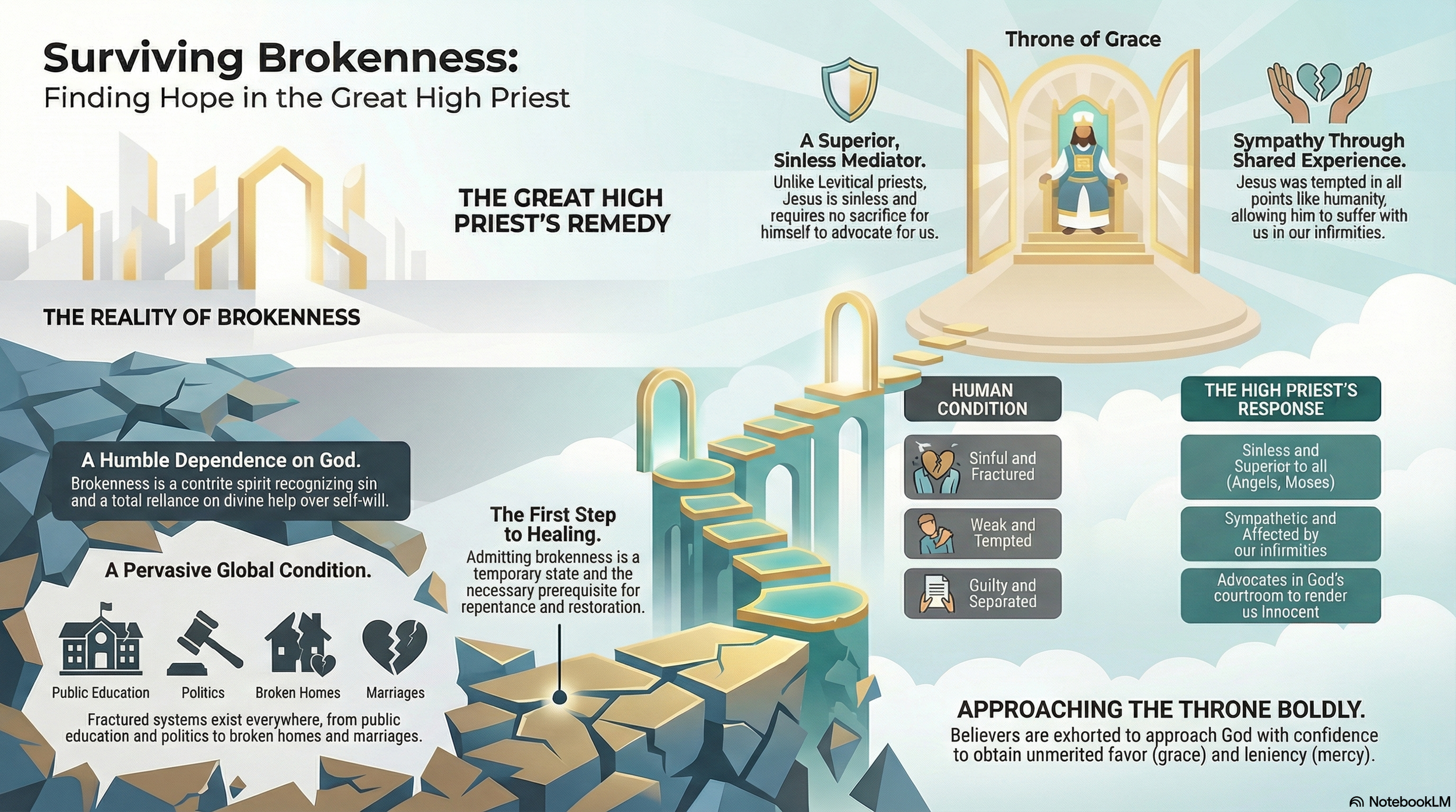
We live in a broken world. Broken homes, broken systems, broken relationships — and if we're honest, broken people. From the classroom to the courtroom, from public education to politics, the evidence of fracture is everywhere. But here's the good news that Dr. Avery Finch brought to the congregation this Lord's Day morning: brokenness doesn't have to be the end of the story. In fact, it's where healing begins — because we have a great High Priest who specializes in putting broken things back together.
Admitting We're Broken
Dr. Finch didn't sugarcoat it. He opened with a candid admission that resonated with every person in the room: "I'm broken." But he was quick to point out the beauty in that honesty. As he explained, brokenness is a humble, contrite spirit that recognizes sin and total dependence on God. It stands in stark contrast to the self-will and pride that actually block our healing.
The key insight? Brokenness is temporary. It's not a permanent address — it's a starting point. Because we have a Savior who bore a cross so that broken people like us could be made whole again. As Dr. Finch put it, you can become "unbroken." But it begins with admitting where you are.
Why We Need a High Priest
To understand why Jesus matters in our brokenness, Dr. Finch took the congregation on a journey through the Levitical priesthood. Under the Mosaic Law, the high priest served as the primary mediator between God and Israel. Descended from Aaron through the tribe of Levi, this priest carried enormous responsibility — including the annual Day of Atonement, when he offered sacrifices for his own sins and the sins of the people.
Dr. Finch painted a vivid picture: when the high priest entered the Most Holy Place, he went alone into the very presence of God. The stakes were so high that a rope was tied to his leg. If he made one mistake — one unconfessed sin, one procedural error — he would drop dead, and the other priests would have to pull him out. That's how seriously God took holiness.
But here's where it gets good. Jesus changed everything.
Jesus: The Great High Priest
Walking through Hebrews chapters 1 through 4, Dr. Finch built a powerful Christological case. Jesus is superior to the angels (Hebrews 1:5–6). He took on human flesh and tasted death for every one of us (Hebrews 2:8–9). He is greater than Moses himself — faithful not as a servant in God's house, but as the Son over God's house (Hebrews 3:3–6). And in Hebrews 4, the writer brings it all home to the throne of grace.
Verse 14 declares that we have a "great" High Priest — not just any high priest, but a megas, divinely appointed, sinless, qualified for direct access to God. This High Priest has "passed into the heavens." He died, rose, defeated death, and ascended to sit at the right hand of the Father. As Dr. Finch emphasized, "Son of God" indicates intimate relationship, identity, inheritance, and position.
Verse 15 reveals something breathtaking: this great High Priest sympathizes with our weaknesses. The Greek word means to suffer with, to be affected by another's condition. Jesus was tempted in every way we are — yet without sin (Matthew 4). He knows what you're going through because He walked through it Himself.
Verse 16 is the crescendo — the invitation that changes everything. We are told to "come boldly" to the throne of grace. Dr. Finch unpacked that phrase with passion: boldly means the absence of fear, confidence, and cheerful courage. It means coming with permission and privilege. And the reward? We obtain mercy — God extending love and leniency to offenders — and we find grace — His unmerited favor — to help in our time of need.
The Courtroom of Heaven
One of Dr. Finch's most powerful illustrations came near the close. He described Jesus as our advocate in the courtroom of God. When the Father declares us guilty — and we are guilty, because we've broken His law, His precepts, His commandments — Jesus stands up and pleads our case. He tells the Father about the good in us, about our faithfulness, about our potential. And His advocacy renders the guilty innocent. That's what a great High Priest does.
Barry's Perspective: Dr. Avery Finch brought fire and heart to the pulpit this Sunday, and I'm grateful he stepped in for Dr. Price. His teaching style — drawing from his work as an educator, his personal vulnerability, and his deep love for Scripture — made Hebrews 4 come alive in a fresh way. This is the kind of preaching that reaches the broken where they are and lifts them to the throne of grace.
This Week's Challenge: This week, I challenge you to take Dr. Finch's message to heart — literally. Identify one area of brokenness in your life that you've been hiding behind pride or self-will. Write it down privately, bring it before God in prayer, and "come boldly" to His throne of grace (Hebrews 4:16). Don't come timidly. Don't come with fear. Come with the confidence that your High Priest is already advocating for you. Then share your experience with a trusted brother or sister in Christ before next Sunday.
Small Group Discussion Questions:
Dr. Finch defined brokenness as "a humble, contrite spirit recognizing sin and total dependence on God." How does this definition differ from how our culture typically views brokenness? Read Psalm 51:17 — how does David's experience connect to this teaching?
The Levitical high priest had a rope tied to his leg in case he died in the Most Holy Place. What does this detail teach us about the holiness of God and the seriousness of approaching Him? How does Jesus change our access to God's presence (Hebrews 10:19–22)?
In Hebrews 4:15, we learn that Jesus "was in all points tempted as we are, yet without sin." How does knowing that Jesus experienced real temptation affect the way you pray to Him during your own struggles? Is there a temptation you've been reluctant to bring to God?
Dr. Finch said the Greek word for "hold fast" (krateo) comes from Kratos, the god of war — meaning strength and power. What does it look like to hold fast to your profession of faith with that kind of strength in your daily life? What threatens to make you let go?
Hebrews 4:16 tells us to "come boldly" to the throne of grace. Dr. Finch described this as coming with "permission and privilege." What keeps people from approaching God with boldness? How can we help each other overcome that hesitation?
Dr. Avery Finch reminded us that in our moments of brokenness, we can survive — because of our High Priest. Our healing, survival, endurance, hope, and remedy all come from approaching God's throne. If you missed this powerful message, I encourage you to listen to the full sermon. There's somebody that needs to approach God's throne today. The lesson is yours.
The Capacity to Survive Our Brokenness
A Quiz from Priceless Lessons - Guest Speaker Dr. Finch
"For we do not have a high priest who is unable to sympathize with our weaknesses, but one who in every respect has been tempted as we are, yet without sin. Let us therefore come boldly to the throne of grace, that we may obtain mercy and find grace to help in time of need."
— Hebrews 4:15-16
Test your understanding of this powerful sermon on brokenness, the high priesthood of Jesus, and God's invitation to come boldly to His throne of grace.
How to Play
- Read the term on the left column
- Click the term to select it (it will highlight with a gold border)
- Find the matching definition in the right column and click it
- If you match correctly, both items will turn green and lock in place
- If you don't match correctly, the items will flash red and deselect
- Match all 8 pairs to complete the game!