
May 2026
Date Time: 2026-05-13 18:24:43 Location: Schrader Lane CoC Zoom Adult Class Instructor: Hubie Harris
Summary
This lecture continues a study on avoiding worldliness, focusing on identifying and abstaining from worldly practices that have infiltrated the church. The instructor, Brother Harris, identifies worldliness as a major problem for the church, emphasizing that Christians are in the world but not of it. The session reviews past topics like lustfulness and boasting before delving into a detailed discussion on "not sharing" or stinginess, and beginning a discussion on inappropriate clothing. The lecture explores biblical perspectives on generosity, the practical challenges of charitable giving, and the non-monetary aspects of stinginess, such as time and compassion. It then transitions to defining inappropriate clothing and its dangers, setting the stage for a more in-depth discussion in the next session.
Knowledge Points
1. Avoiding Worldliness
- Objective of the Study
- The primary goal is to identify worldliness and avoid its practice.
- The instructor quotes a saying: "he looked for the church in the world and found the world in the church," highlighting that worldliness is one of the biggest problems the church faces.
- Christians are challenged to live for Christ in a world where the majority are not Christ-inclined and are influenced by the devil, whose objective is to make people lose their souls.
- List of Worldly Practices Discussed
- The lecture is part of a series covering various worldly traits.
- Previously discussed topics include: Indifference to God, inappropriate language, alcohol drinking, stealing, lying, gambling, lustfulness, fornication, and boasting.
- Topics for future discussion include: Bullying, dancing, gossiping, fighting, deceiving, drug abuse, idolatry, quarreling, participating in denominationalism, racism, road rage, choosing inappropriate friends, condoning abortion, and smoking.
2. Stinginess (Not Sharing)
- Definition of Stinginess
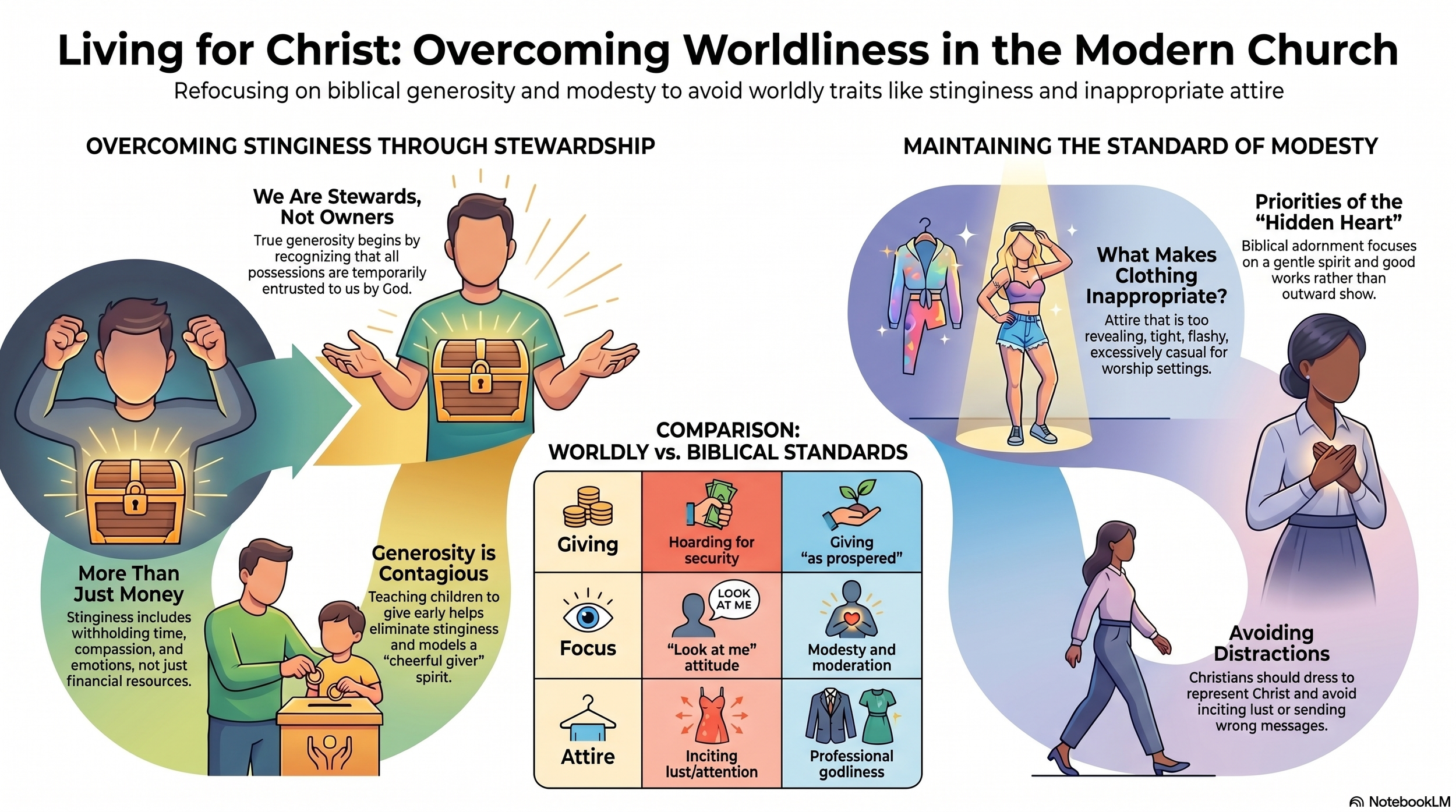
- A stingy person is someone unwilling to spend, give, or share money or possessions. It is characterized by a lack of generosity.
- The instructor notes that while many worldly people are generous, they may have ulterior motives. Stinginess is presented as a devilish trait Christians must avoid.
- Biblical Condemnation of Stinginess
- Proverbs 28:22: "A stingy man hastens after wealth and does not know that poverty will come upon him."
- Proverbs 11:24: "One gives freely yet grows all the richer. Another withholds what he should give, and only suffers want."
- 1 Timothy 6:18: Christians should be "ready willing to give and share."
- Luke 6:38: Jesus' words, "give and it will be given to you."
- Proverbs 19:17: Encourages being "generous to the poor."
- 2 Corinthians 9:7: Advocates for being a "cheerful giver."
- Acts 20:35: States that "Giving is better than receiving."
- Practical Application of Generosity
- Christians are not obligated to give to every cause but must ensure their generosity is in harmony with God's word.
- A participant, Mr. Ridley, notes that giving to charitable organizations can lead to being bombarded with donation requests, as these groups seem to exchange mailing lists.
- Giving must be done with care, as it's not always clear who one is giving to. The instructor prefers giving to the local church first, letting benevolence flow from there, as outside entities may not be trustworthy.
- Psychological and Emotional Aspects of Stinginess
- Stinginess can stem from fear or insecurity, possibly due to past experiences of being "burned" after being generous.
- Stinginess is not limited to money; it can also involve one's time and emotions. One participant noted that not helping someone when you are able to can be a form of stinginess. Another participant, Victoria Green, added via chat that a "lack of compassion is a form of being stingy."
- Obligation and Method of Giving
- Giving on the Lord's Day is a command, not an option, for all Christians, regardless of age or income level, including those on Social Security.
- One should give "as we've been prospered." The amount may decrease if one's income decreases (e.g., upon retirement), but the principle of giving a set portion remains.
- Children should be taught to give from an early age from their allowance or jobs.
- The example of Dorcas from the Bible is used to illustrate giving through skills and not just money.
- The story of Abigail and her foolish, stingy husband Nabal is cited as an example where stinginess could have led to disaster, while generosity saved lives.
- Stewardship and Influence
- A key perspective is that Christians are merely stewards of God's resources, not true owners, which should make it easier to share.
- Generosity can be taught and is contagious. Children learn to be generous by seeing it modeled in the home.
3. Inappropriate Clothing
- Definition of Inappropriate Clothing
- Clothing that is not suitable, respectful, or safe for a specific context, venue, or social situation.
- It is an issue in the world that is trying to make its way into the church. Christians should set the moral standard for clothing, not follow the world's lead.
- Characteristics of Inappropriate Clothing
- It is too revealing, too tight, too flashy, or too casual.
- It is not gender-specific.
- It is based on improper motives.
- Biblical Principles on Clothing
- 1 Timothy 2:9-10: Women should adorn themselves in modest apparel with propriety and moderation, focusing on good works rather than costly clothing or elaborate hairstyles.
- 1 Peter 3:3-4: Adornment should be the "hidden person of the heart" with a gentle and quiet spirit, not merely outward appearance.
- Deuteronomy 22:5: A woman shall not wear a man's garment, nor a man a woman's garment, a principle from the Old Law that is still considered valid.
- Exodus 20:26: Priests were instructed not to go up by steps to the altar in a way that would expose their nakedness.
- Reasons Christians Should Avoid Inappropriate Clothing
- It could incite lust.
- It could send the wrong message to others.
- It could expose one's nakedness.
- It could be worn for attention.
- It is against the law of Christ.
- Discussion on "Too Casual" Attire
- Casual attire, while acceptable on designated "casual days," can be taken to an extreme.
- Examples of "too casual" for a worship setting could include clothing with strange writing, pants with knees out, or pajamas and house slippers as seen in public places like Walmart.
- The concern is that people may "push the envelope," and the devil could use the opportunity to turn a positive expression into a sinful situation.
- Inappropriate Clothing and Lust
- Some clothing is designed by manufacturers with the express purpose of inciting lust.
- This is an issue for both men and women, but the lecture notes that men, in a corporate worship setting, should not have to deal with the distraction of inappropriately dressed women.
- The instructor mentioned a sermon where every man in a congregation admitted to having an issue with lust, highlighting the seriousness of the topic.
Assignments
-
- Reflect on personal practices of generosity to ensure they are in harmony with God's word and not driven by stinginess in any form (money, time, or compassion).
-
- Evaluate one's own wardrobe to ensure it aligns with the principles of modest and appropriate dress for a Christian, especially for corporate worship.
-
- Parents and guardians are encouraged to teach children the principle and practice of generous giving from an early age.
-
- Come prepared for the next session to continue the discussion on "Why should Christians avoid inappropriate clothing?" starting with the point that it can incite lust.
Avoiding Worldliness:
Stinginess & Inappropriate Clothing
Stinginess & Inappropriate Clothing
Test your understanding of generosity, stewardship, modesty, and Christian discernment through this interactive Barry’s Bureau quiz experience.
“The object of this study is to identify worldliness and to avoid the practice of such.”
7 Questions
Instant Feedback
Retake + Share