
June 10, 2026
Date Time: 2026-06-03 18:29:19 Location: SLCC Zoom Adult Bible Study Instructor: Hubie Harris
Summary
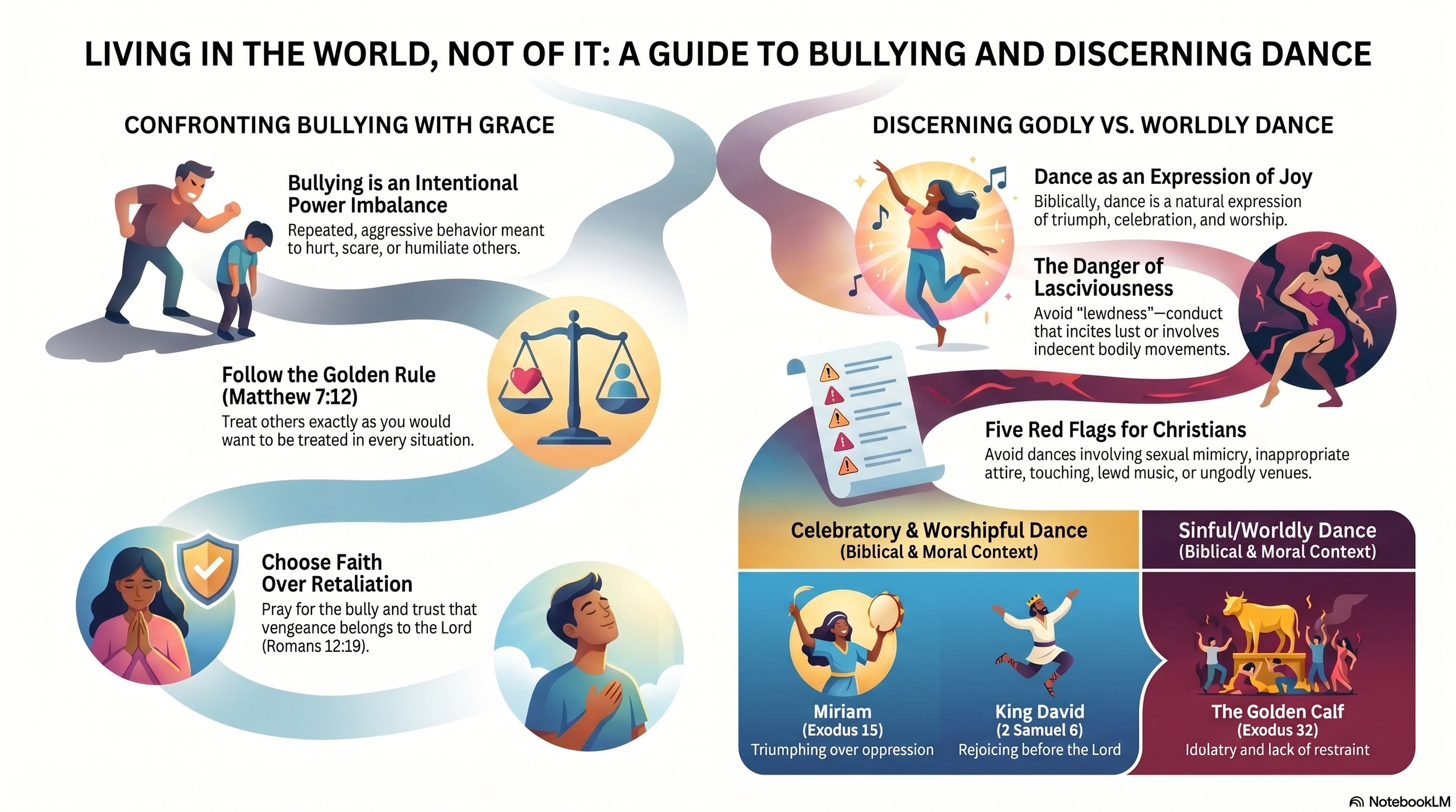
This lecture, led by Brother Harris, is part of a series on avoiding worldliness. The session focuses on identifying and refraining from worldly practices that conflict with Christian living. It begins by defining bullying and exploring its forms from childhood to adulthood, including coercion and systemic issues. The discussion offers biblical guidance for responding to bullying—emphasizing non-retaliation, prayer, and trusting God’s justice—supported by personal anecdotes from class members. The lecture then turns to dancing, examining its biblical portrayal both as joyful celebration and in sinful contexts. The instructor defines lasciviousness and explains how dancing becomes sinful when it involves movements that mimic sexual acts, inappropriate attire, touching, music, or settings.
Key Points
1. Introduction to the Study on Avoiding Worldliness
- Study Objective
- The main goal is to identify worldliness and avoid practicing it.
- Worldliness is cited as one of the church’s biggest problems.
- The core challenge is living for Christ in a world largely not inclined toward Him, influenced by the devil, whose objective is to help people lose their souls.
- Series Overview and Progress
- Previously covered topics: indifference to God, inappropriate language, alcohol drinking, stealing, lying, gambling, lustfulness, fornication, boasting, not sharing, and inappropriate clothing.
- This session begins with bullying and plans to cover dancing, gossiping, fighting, conning, deceiving people, drug abuse, idolatry, quarreling, denominationalism, racism, road rage, choosing inappropriate friends, condoning abortion, and smoking in future sessions.
- Three studies remain in the current quarter, including this one. Brother Harris will yield to a new study in the third quarter.
2. Bullying
- Definition of Bullying
- Bullying is unwanted, repeated, intentional aggressive behavior meant to hurt, scare, or humiliate someone, typically involving a power imbalance.
- Evil people, influenced by the devil, often have no conscience regarding such actions.
- Biblical Teachings Against Bullying
- Christians are called to follow God’s word in their interactions.
- Key verses:
- Luke 6:31: Do to others as you would have them do to you.
- Matthew 7:12: The Golden Rule, which is the law and the prophets.
- Zechariah 7:10: Do not oppress or plan evil against others.
- 1 Thessalonians 5:15: Do good to everyone.
- Mark 12:31: Love everyone as we love ourselves.
- Ephesians 4:32: Be kind to others.
- Hebrews 12:14: Strive for peace with everyone.
- Bullying stems from hatred and bitterness—of the devil. Christians who bully must repent.
- Bullying must be kept in check everywhere: homes, neighborhoods, workplaces, schools, and the church.
- How to Respond to Being Bullied
- Biblical Guidance:
- Luke 6 (Sermon on the Mount) provides a model: love your enemies, do good to those who hate you, turn the other cheek, and do not withhold your possessions.
- Choose non-retaliation.
- Love the bully (Matthew 5:44).
- Pray for the bully.
- Trust that vengeance belongs to the Lord (Romans 12:19).
- Overcome evil with good (Romans 12:21).
- Do not fear the bully; put faith and trust in God.
- Practical and Legal Measures:
- Seek help from an established person or authority.
- Call the police if necessary—lawful restraint for extreme situations.
- Biblical Guidance:
- Personal Experiences and Forms of Bullying
- Bullying often starts in elementary school but occurs throughout life: childhood, teenage years, adulthood (even among the elderly).
- Coercion: Adult bullying where people are pressured to “go along to get along,” supporting what they don’t agree with to stay in a social or professional circle.
- Systemic Bullying: Seen nationally, such as in government (Congress, Senate, Supreme Court), where people are pressured to act against what is right.
- Personal stories included childhood bullies on the bus and in the neighborhood, a bullying brother, and a racist boss—highlighting strategies like avoidance, telling a family member, and witnessing God handle the situation.
- A key lesson from adult bullying: learning love, forgiveness, and restraint, and seeing how God systematically resolves the problem.
3. Dancing
- Definition and Biblical Context
- Dancing is moving the body rhythmically and purposefully, usually to music, to express emotions, ideas, or release energy.
- In the Bible, there are no recorded instances of mixed-sex partner dancing as common today. Dancing was communal and separated by gender.
- Examples of Celebratory Dancing in the Bible
- Miriam and the women: Danced with timbrels to celebrate victory over the Egyptians (Exodus 15:20-21).
- King David: Danced before the Lord with all his might when the Ark returned (2 Samuel 6:14-16).
- Women of Israel: Danced to celebrate David’s victory over the Philistine (Goliath) (1 Samuel 18:6-7).
- Psalms: Encourages praising God with dance and instruments (Psalm 149:3; Psalm 150:4).
- Prodigal Son: The older son heard music and dancing upon returning home, signifying celebration (Luke 15:25).
- Jeremiah 31:4: Prophesies Israel will again go forth in the dances of those who rejoice.
- Examples of Sinful Dancing in the Bible
- The Golden Calf: Israel’s dancing around the calf was idolatry that angered Moses (Exodus 32:19-20).
- Herodias’s Daughter: Her dance pleased Herod, leading to a rash oath and John the Baptist’s beheading (Matthew 14:6-11).
- When Dancing Becomes Sinful (Lasciviousness)
- While not explicitly condemned, biblical principles must guide actions to honor God and avoid causing others to stumble.
- Dancing becomes sinful when it crosses into lasciviousness.
- Lasciviousness: wanton manners, filthy words, indecent bodily movements, unchaste handling of males and females, and conduct that incites lust.
- Scripture identifies lewdness (lasciviousness) as a work of the flesh (Galatians 5:19) and a sin proceeding from the heart (Mark 7:21-22).
- Also translated as sensuality and debauchery.
- Ways Dancing Can Cross into Lasciviousness
- Movements that mimic sexual acts: e.g., “bump and grind,” certain slow dances.
- Inappropriate attire.
- Inappropriate touching.
- Inappropriate music.
- Inappropriate places: e.g., a strip club.
- These concerns primarily apply to public displays; actions between a married couple are not considered lascivious.
Assignments
-
- Reflect on the biblical response to bullying—such as loving the bully and choosing non-retaliation—and consider how to apply these principles.
-
- Evaluate contemporary forms of dancing against the biblical principle of avoiding lasciviousness.
-
- Prepare to continue the discussion on dancing and avoiding worldliness in the next session on June 10, 2026.
Barry’s Bureau Bible Quiz
Avoiding Worldliness: Bullying and Dancing
Class Date: June 3, 2026
Instructor: Hubie Harris
Location: SLCC Zoom Adult Bible Study
“The object of this study is to identify worldliness and to avoid the practice of such.”
This 7-question quiz will help you review key Bible principles from the lesson.
Quiz Complete
Your Final Score
/7