
December Lessons
IN THIS LESSON
The ‘Send Me’ Prayer: Availability, Obedience, and the Call to Go
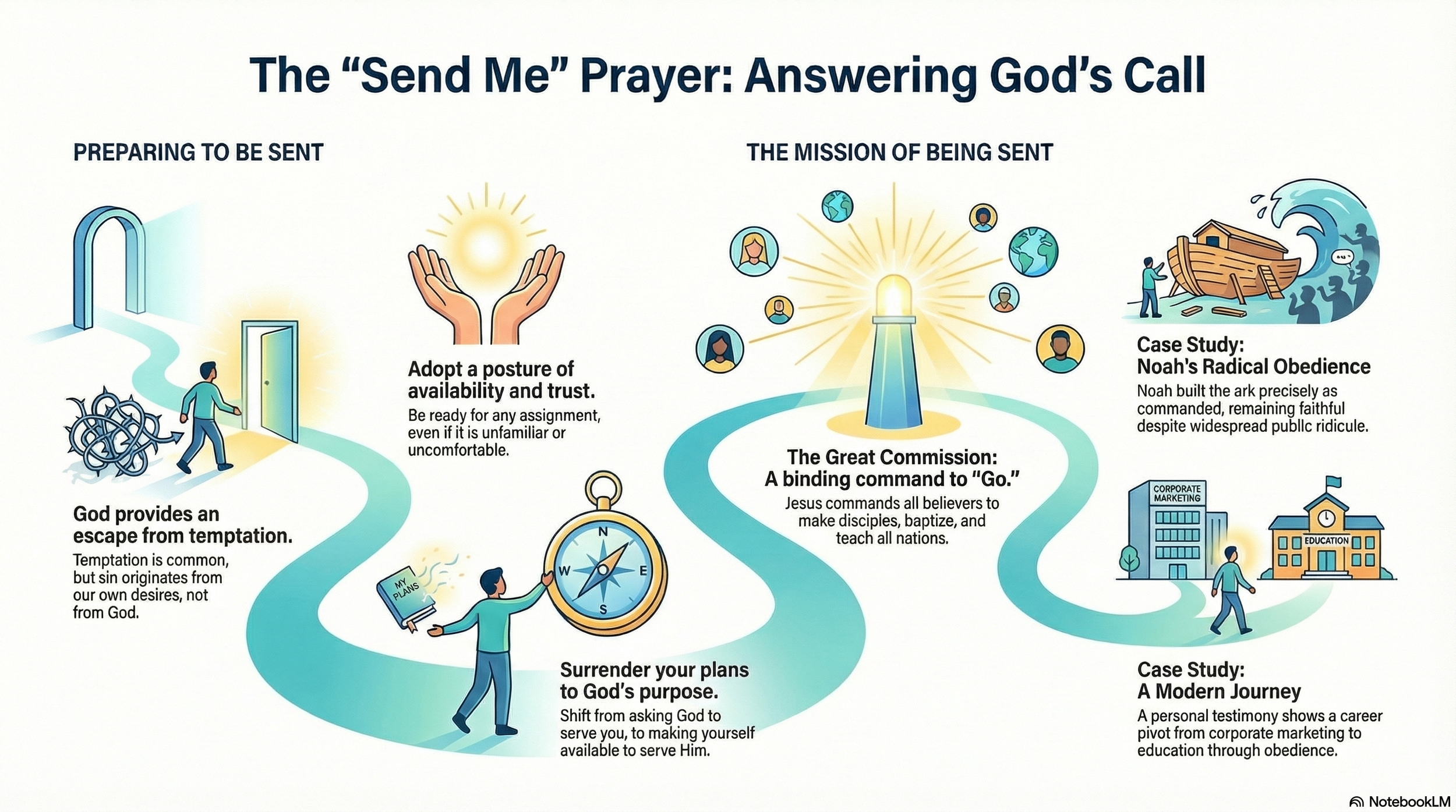
This lesson explores the dangerous prayer “Send me” as a call to availability, obedience, and trust in God’s purposes. Using 1 Corinthians 10:13 and James 1:13–15, it clarifies the nature of temptation, emphasizing that God does not tempt us but faithfully provides a way of escape when we remain connected to Him. The lesson highlights biblical examples of being sent—such as Noah, Abraham, Moses, the apostles, and ultimately Jesus—showing that obedience often requires courage, surrender, and faith amid uncertainty. Special focus is given to the Great Commission as a binding command to go, make disciples, baptize, and teach continually. Through personal testimony and practical church application, students are encouraged to surrender their plans, purify their motives, and make room for God to use their gifts in service. The lesson concludes by challenging believers to move from comfort to commitment, trusting God’s presence as they answer His call.

Dangerous Prayers — Lesson 6 Quiz
10 questions • one at a time • instant feedback + short explanations
Barry’s Bureau
Before you begin…
“Rather than asking God to serve us… what if we told God we are available to serve Him?”
— Lesson 6 (Send Me theme)
Questions10
ModeSelf-directed
FeedbackInstant
Question 1 of 10
Score: 0
Answered0
Correct0
Current1/10
Quiz Complete!
0/10
Nice work
🛡️ Escape Route Challenge
Lesson 6: “Send Me”
Scenario Quiz
Practice spotting temptation’s pattern, God’s “way of escape,” and what faithful obedience looks like.
How to play: Answer one scenario at a time. You’ll see instant feedback and a short “why.” Try to finish with a strong score and a steady streak.
Progress
0/0
Score
0
Streak
0
Press “Start” to begin.
Lesson anchor: “Temptation is common… God is faithful… and provides a way out.” (cf. 1 Cor. 10:13)
Quick Reminders (from Lesson 6)
- God doesn’t tempt — desire starts within (James 1:13–15).
- Stay “under the umbrella” of obedience and relationship with God.
- Escape routes: Scripture, prayer, boundaries, accountability.
- “Send me” = availability + trust + surrender of plans.
- The Great Commission is a command: go, make disciples, baptize, teach (Matt. 28:18–20).
- Examples: Noah obeyed under ridicule; Abraham stepped out without full visibility.
Tip: When a choice is wrong, read the “why” carefully — that’s where the learning sticks.
🧭 Send Me Path Builder
Order-the-Steps Puzzle
Round 1 of 2
Arrange the steps to match the lesson’s key biblical patterns. Use ▲/▼ to move tiles (easy on mobile).
How to play: Put the tiles in the correct order, then tap Check Order. You’ll earn points for each round you complete.
Round
1/2
Score
0
Accuracy
—
Round 1: How temptation becomes sin
Hint: James shows an internal progression (James 1:13–15).
Lesson tie-in: staying “under the umbrella” of obedience often means recognizing the chain early and taking the escape route (1 Cor. 10:13).
What you’re practicing
- James 1 pattern: desire → enticement → sin → death.
- Great Commission pattern: go → make disciples → baptize → teach.
- “Send me” posture: availability + trust + surrender of plans.
Tip: If you miss the order, reread the verse idea tied to that round and try again.