
July 2026
IN THIS LESSON
Date Time: 2026-07-01 18:28:17 Location: Zoom Bible Class SLCC Instructor: Jon Pinkerton
Summary
This series of lectures, led by Jon Pinkerton with contributions from Barry Johnson and Darryl, provides a detailed historical and cultural background for the Book of Romans, alongside an in-depth analysis of its introduction. The sessions explain the setting in which Paul wrote his epistle around 56–57 AD from Corinth, highlighting that he had never been to Rome at the time. The lectures explore the origins of the Roman church, likely begun by Pentecost attendees returning to Rome, which meant the church had faith but lacked mature apostolic teaching. Key historical events are discussed, such as Emperor Claudius's expulsion of Jews from Rome, which created a mixed congregation of Jews and Gentiles. The lectures emphasize that Romans is Paul’s most comprehensive and scholarly explanation of the gospel, intended to establish a firm doctrinal foundation for the believers. The letter addresses sin, sanctification, and the validation of Jesus Christ’s divinity through prophecy, power, and resurrection. Paul’s goal was to build up the church, impart spiritual gifts, foster unity, and evangelize. The introduction (Romans 1:16–17) is identified as a key passage, explaining the gospel as the power of God for salvation to all who believe and highlighting the progressive nature of faith ("from faith to faith"). The series connects Paul’s doctrinal rigor to his own transformative encounter with Jesus (Acts 9) and concludes by calling believers to ground their faith in Scripture, the gospel, and the deity of Christ. Ultimately, the lectures set the stage for understanding why Paul wrote such a doctrinally heavy letter: to provide foundational teaching and mature a church that lacked direct apostolic guidance.
Knowledge Points
1. Historical Context, Authorship, and Motivation
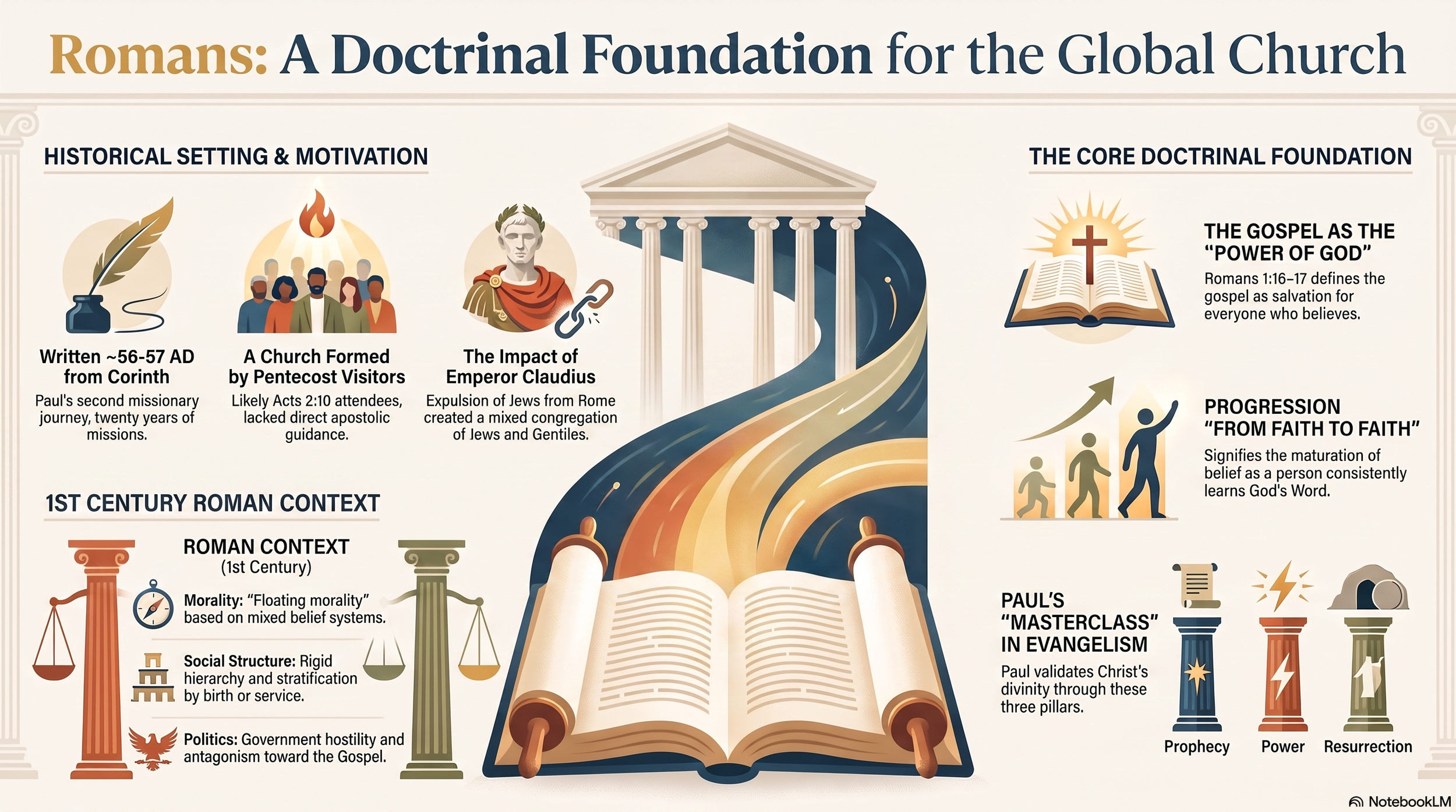
- Author and Timing: The letter was written by the Apostle Paul around 56-57 AD from Corinth, during his second missionary journey. By this time, Paul had endured about twenty years of rugged missions, including persecution and expulsion from various cities.
- Paul's Relationship with the Roman Church: Paul had never been to Rome when he wrote the letter. His motivation came after meeting Roman Christians like Aquila and Priscilla and hearing about their faith. He longed to visit to teach, impart spiritual gifts, and ensure the church's maturity and unity.
- Purpose of the Letter: Romans is considered Paul's "doctoral thesis"—his longest, most complete, and scholarly explanation of the gospel. It was written to provide a solid doctrinal foundation for a church he did not personally establish, enabling believers to build their faith on a firm, independent basis.
- God's Sovereignty: Although Paul planned to go to Rome, the events that would lead him there (in chains) had not yet occurred. The lectures emphasize that God's sovereign plan and the Holy Spirit orchestrated his eventual journey.
2. The Church in Rome: Origins and Composition
- Founding of the Church: The Roman church was likely established by visitors from Rome who were present at Pentecost (Acts 2:10) and brought the message back. This origin meant the church was "full of faith, but the knowledge might have been a little lacking," as it missed the apostles' later, more mature teachings.
- Political and Social Climate: Around 50-56 AD, Emperor Claudius expelled Jews from Rome due to conflicts between traditional Jews and Jewish Christians. This historical event shaped the church's composition, which included both Jews and a large number of Gentiles. By the time Paul arrived, Nero was emperor.
- Cultural Parallels: The lectures draw parallels between Roman culture—a mix of beliefs, a "floating morality," a rigid social hierarchy, and government hostility toward the gospel—and modern American culture.
- Need for Doctrinal Unity: Paul's doctrinal depth was necessary to bridge the gap between Jewish and Gentile believers. The Gentiles lacked a deep understanding of the Old Testament history that underpinned Christianity, and Paul aimed to provide this foundation to prevent strife and foster unity.
3. Analysis of Romans Chapter 1: The Gospel's Foundation
- Introduction of Key Doctrines (Romans 1:1-4):
- Paul introduces himself as an apostle "separated unto the gospel of God," establishing the concept of sanctification.
- He grounds the gospel in Old Testament prophecies, providing a verifiable foundation.
- He establishes Jesus's identity as a descendant of David (fulfilling prophecy) and "declared the Son of God with power...by the resurrection from the dead."
- The Gospel as the Power of God (Romans 1:16-17):
- This passage is central, defining the gospel as "the power of God unto salvation to everyone that believes; to the Jew first, and also to the Greek."
- The righteousness of God is "revealed from faith to faith," signifying a progressive maturation of belief as one learns God's Word.
- The phrase "the just shall live by faith" (citing Habakkuk 2:4) grounds the Christian life in ongoing faith in Scripture.
- Paul’s Commission and Desire to Visit (Romans 1:5-15):
- The letter is addressed to "all that be in Rome, beloved of God, called to be saints."
- Paul expresses his deep desire to visit them to "impart... some spiritual gift" for their establishment and for mutual encouragement.
- He states his debt to preach the gospel to all people—Greeks and barbarians, wise and unwise.
4. Theological and Practical Implications
- Foundational Requirements: To understand Romans, one must have a foundational knowledge of Scripture, the gospel's message, and the deity of Jesus Christ. Paul models this by supporting his claims with scriptural evidence.
- Paul's Conversion (Acts 9): Paul's transformative encounter with Jesus on the road to Damascus is presented as the source of his deep conviction. This experience of being blinded and then commissioned by Jesus fueled his unwavering commitment.
- Application for Believers: While not all believers have such a dramatic experience, Paul’s example demonstrates the power of what Christ can do in and through a person. His method serves as a "masterclass" in evangelism and church-building: providing a solid, defensible foundation for faith.
Assignments
-
- Review Acts 9 to understand the transformative nature of Paul’s conversion experience.
-
- Read Romans 1:16–17 and cross-reference Old Testament passages like Habakkuk 2:4 to grasp the scriptural foundation of "the just shall live by faith."
-
- Conduct a comparative study between Roman culture during Paul's time and current American culture.
-
- Outline the foundational doctrines necessary for studying Romans: the gospel's nature, Christ's deity, and the unity of Jews and Gentiles in salvation.
-
- Read, meditate on, and apply the Word of God, following the example of Paul's instruction.