
Nov 2025 Lessons
IN THIS LESSON - Presented November 23, 2025
Priesthood and Maturity
Scripture Focus: Hebrews 5:1–14
Key Topics: The High Priesthood, The Order of Melchizedek, Suffering and Obedience, Spiritual Maturity vs. Immaturity
In this lesson, we delve into Hebrews Chapter 5, a pivotal section of scripture that bridges the gap between the Old Testament Levitical system and the superior priesthood of Jesus Christ. This study not only defines the role of a mediator between God and man but also issues a challenging call for every believer to move beyond spiritual infancy and embrace "solid food."
1. The Qualifications of a High Priest
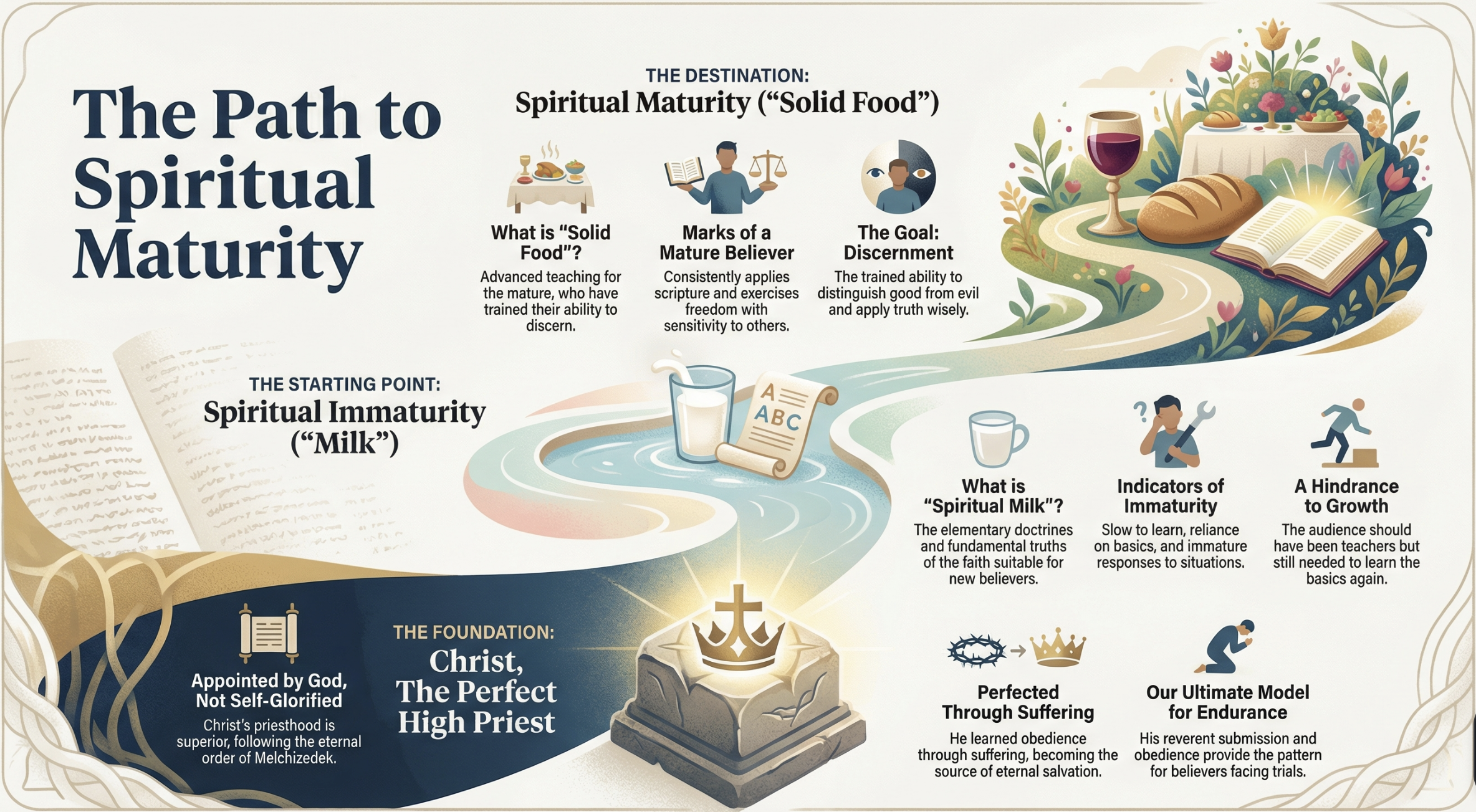
The lesson begins by examining the God-ordained requirements for a high priest under the Old Law. We learn that a high priest must be selected from among men and appointed by God—never self-appointed. Crucially, the high priest must possess compassion. Because he is subject to his own human weaknesses, he is able to deal gently with those who are ignorant or going astray. This shared experience allows for true empathy as he offers sacrifices for both the people's sins and his own.
2. Christ: The Perfect High Priest
We contrast the earthly priesthood with the divine appointment of Jesus Christ. Unlike the political maneuvering seen in the priesthood during the first century, Christ did not glorify Himself. Instead, He was declared a priest forever by God in the "order of Melchizedek". We explore the mysterious figure of Melchizedek—a king-priest who serves as a "type" or foreshadowing of Christ’s eternal and superior priesthood, distinct from the lineage of Aaron.
3. Learning Obedience Through Suffering
One of the most profound aspects of this lesson is the humanity of Jesus. During His earthly life, He offered up prayers with loud cries and tears. Though He was the Son, He "learned obedience from what He suffered". This suffering did not correct disobedience but rather tested and proved it, qualifying Him to become the "source of eternal salvation" for all who obey Him. This stands as a powerful model for us: suffering can refine our faith and perfect our endurance.
4. The Warning: Milk vs. Solid Food
The lesson concludes with a stern but necessary warning against spiritual stagnation. The writer rebukes the audience for being "slow to learn". By this time, they ought to have been teachers, yet they still needed someone to teach them the elementary truths (spiritual "milk").
* Milk: Represents basic doctrines suitable for spiritual infants.
* Solid Food: Represents advanced teaching for the mature.
True spiritual maturity is defined by discernment—the trained ability to distinguish good from evil through constant practice and use of God's Word. We discuss the danger of apostasy, emphasizing that it is not a mere stumble but a deliberate abandonment of the faith, and we encourage every student to press on toward maturity.
Hebrews Priesthood and Maturity Quiz
Welcome to the "Hebrews Priesthood and Maturity" quiz! This 10-question challenge will test your understanding of the lesson material.
"His audience is slow to learn, and they still need elementary instruction"
Question 1 of 10
Quiz Complete!
Your final score is:
0 / 10
Match the Truth: Hebrews Lesson 7
Match the **Key Term** on the left with its correct **Definition** on the right. Click one from each side to make a match!
There are 8 matches to complete. Ready?
Key Terms
Definitions
Matching Complete!
You matched all key concepts!
Time to complete:
0.00s
Fact or Fallacy?
Hebrews Lesson 7
Test your recall! Quickly decide if the statement is a FACT or a FALLACY.
There are 10 questions. Aim for a perfect score!
Question 1 of 10
Loading...
Challenge Complete!
Your Final Score:
0/10