
October 2026
Date Time: 2026-10-07 18:24:14 Location: Schrader Lane Zoom Bible class Instructor: John Pinkerton
Summary
The lecture reviews Romans chapters 1 through 9 and transitions into chapter 10, emphasizing that God’s sovereign will takes precedence over all things and that righteousness and salvation come through faith in Jesus Christ rather than lineage or works of the law. Paul’s argument in Romans 9 shows that God may raise up individuals (e.g., Pharaoh, Nebuchadnezzar) for His purposes without implying divine favor toward them. God has mercy on whom He wills and hardens whom He wills, yet human beings remain free moral agents accountable for their choices. The imagery of the potter and clay highlights God’s authority: vessels of wrath and vessels of mercy reveal a contrast meant to display God’s power and purposes, with the called—including both Jews and Gentiles—receiving mercy through faith. Hosea’s prophecies about calling “those who were not My people” and making them “sons of the living God” affirm the inclusion of Gentiles, ending any claim to salvation based on bloodline. Eternal life is a promise of the new covenant through Christ, accessed by grace through faith and obedience to the gospel, not through adherence to the old covenant. Isaiah’s warnings show that only a remnant of Israel would be saved; without this remnant, Israel would have faced total destruction like Sodom and Gomorrah. This remnant is tied to faith and obedience, not ancestry. Gentiles attained righteousness by faith, while Israel, pursuing righteousness “as it were by works of the law,” failed to attain it because they did not seek it through faith. Israel stumbled over the “stumbling stone” laid in Zion—Christ—and missed the righteousness God revealed. The promise to Abraham was always connected to faith, and Paul brings forward the Scriptures to demonstrate that the Messiah—“the way, the truth, and the life”—fulfills God’s plan. Moving into Romans 10, the instructor highlights Paul’s prayer for Israel’s salvation, noting their zeal not according to knowledge. Christ is the end of the law for righteousness to everyone who believes. Salvation involves hearing the word, believing that God raised Jesus from the dead, and confessing Jesus as Lord, but true confession and belief must be accompanied by obedience—repentance and baptism as commanded by Christ. Grace is not of works; it is a precious gift to be honored and pursued, and a “remnant according to the election of grace” has always existed among Israel. Paul wrote to the Romans to correct errors, mature their faith, and unite Jewish and Gentile Christians amid conflicts and Judaizing influences, aiming to form one people in Christ.
Knowledge Points
1. God’s Will and Sovereign Purpose (Romans 9)
- God’s will, way, and purpose are preeminent and will stand above all.
- God may raise leaders (e.g., Pharaoh) to display His power and make His name known; being raised up does not equal divine favor.
- God has mercy on whom He wills and hardens whom He wills; popular excuses like “God made me this way” cannot justify sin.
2. Human Accountability and Free Moral Agency
- “Who are you, O man, to reply against God?” The potter has authority over the clay.
- Vessels of wrath versus vessels of mercy reveal God’s longsuffering and the calling of Jews and Gentiles.
- Humans are free moral agents responsible to choose God’s will over sin.
3. Gentile Inclusion and the End of Bloodline Claims
- Hosea’s prophecy: God calls those who were not His people; Gentiles are called “sons of the living God.”
- Salvation is not based on physical descent; eternal life is a new covenant promise through faith in Christ.
4. The Remnant of Israel and Prophetic Warnings
- Only a remnant of Israel will be saved, grounded in faith and obedience.
- Isaiah and Hosea warned Israel of the coming new covenant realities; without a remnant, Israel would have been as Sodom and Gomorrah.
5. Righteousness by Faith vs. Law
- Gentiles attained righteousness by faith; Israel failed by pursuing it through works of the law rather than faith.
- The promise to Abraham is through faith; one cannot expect the promise’s reward without pursuing it on its terms.
6. The Stumbling Stone and Christ’s Fulfillment
- Israel stumbled over Christ, the rock of offense; whoever believes on Him will not be put to shame.
- The Scriptures consistently pointed to the Messiah; Paul presents a masterful argument that the gospel fulfills God’s longstanding plan.
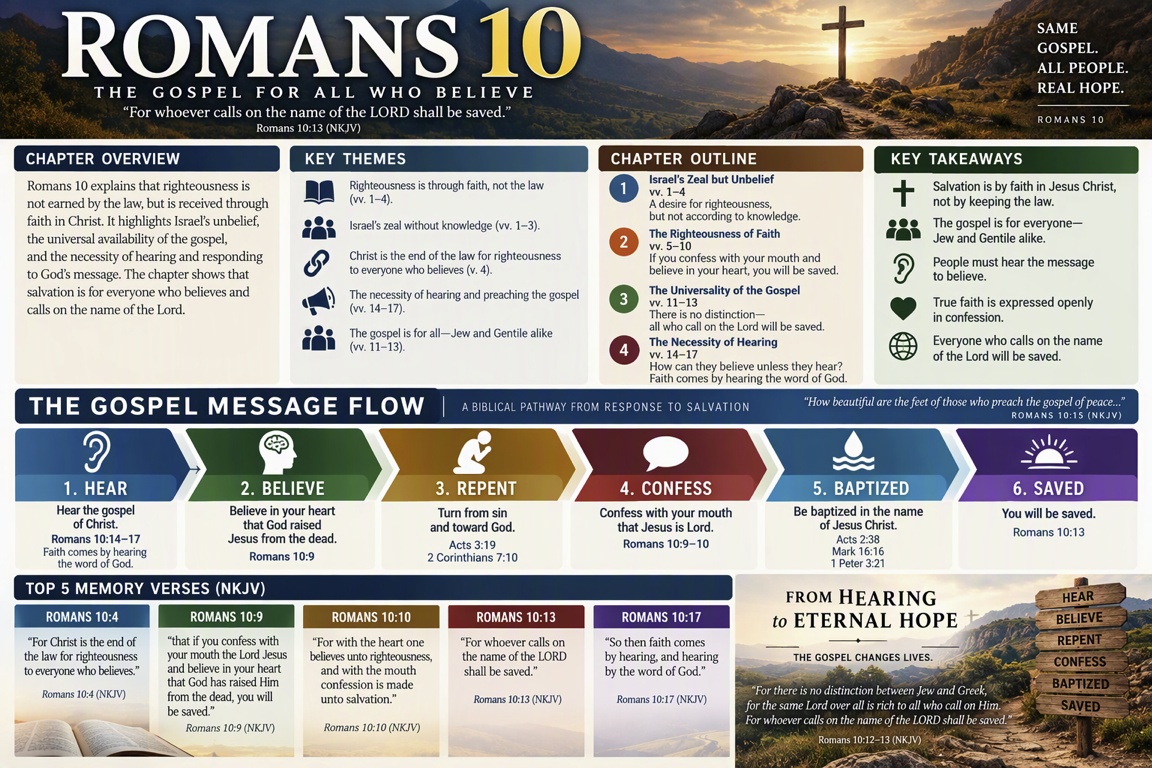
7. Righteousness and Salvation in Romans 10
- Israel’s zeal lacked true knowledge; they tried to establish their own righteousness.
- Christ is the end of the law for righteousness to everyone who believes.
- Salvation entails hearing the word, believing in the resurrection, and confessing Jesus, accompanied by obedience—repentance and baptism.
8. Grace, Remnant, and Israel’s Status
- God has not cast away Israel; they departed from Him.
- There is always a remnant (e.g., the 7,000 in Elijah’s day) according to the election of grace.
- If by grace, then not of works; grace must be honored and pursued wholeheartedly.
9. Paul’s Letter and the Roman Church Context
- The Roman church, formed amid diaspora, needed mature teaching; Judaizers caused conflict between Jewish and Gentile Christians.
- Paul wrote to correct errors, unify believers, and prepare for his visit to Rome.
10. Guidance for Conversations with Different Beliefs
- Listen first; use Scripture the person accepts (e.g., Hosea, Isaiah); ask how they interpret those texts.
- Avoid attacking personal religious experiences; focus on God and truth; involve others when helpful for collaborative reasoning.
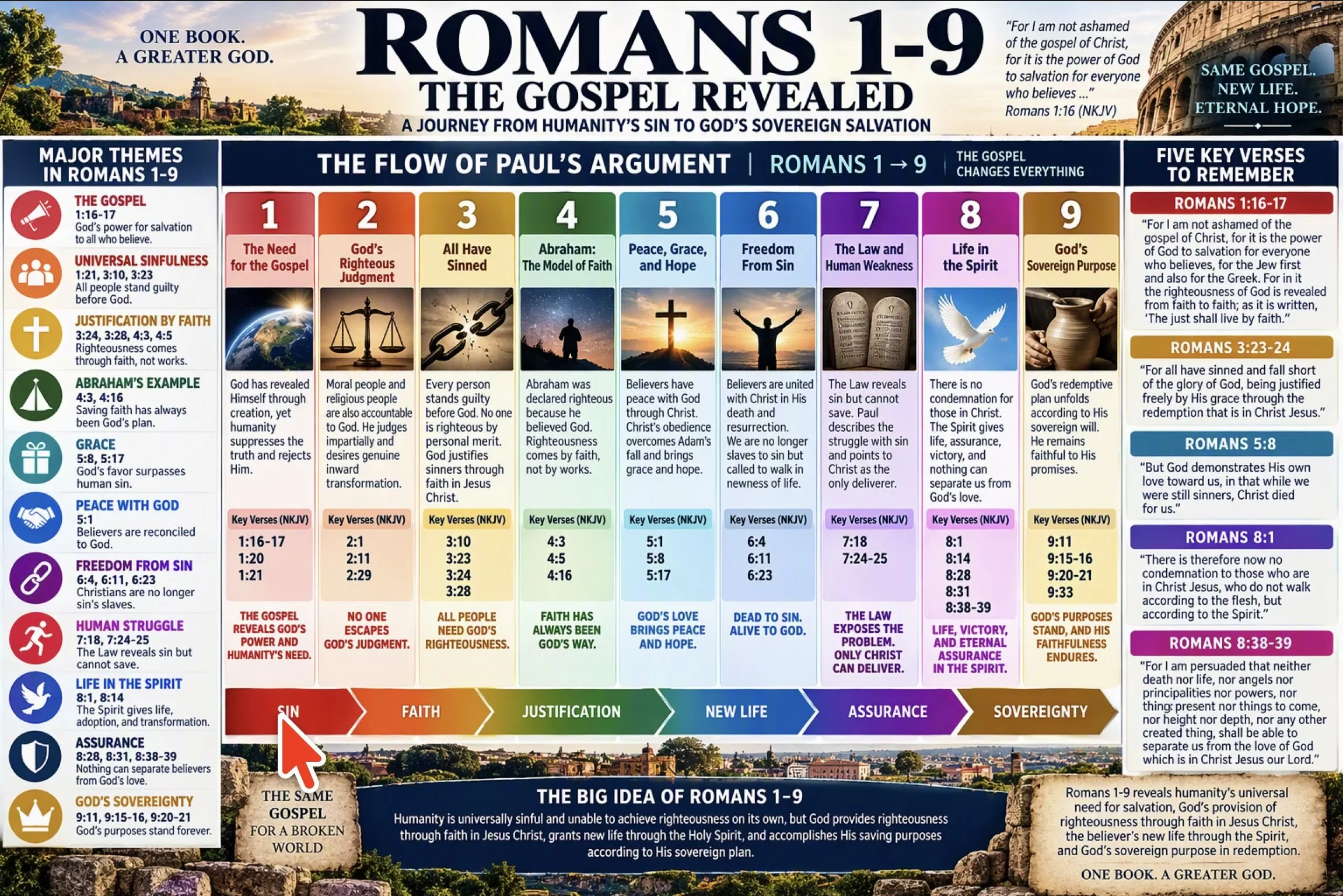
Review of Romans 1–9
- Romans 1: The need for the gospel; it is the power of God to salvation for everyone who believes.
- Romans 2: All have sinned; no one is righteous on their own.
- Romans 3: Justification by faith; grace grants standing despite sin.
- Romans 4: Abraham’s faith is the root of the promise; salvation comes by faith.
- Romans 5: Peace with God through Christ’s sacrifice and the gospel.
- Romans 6: Freedom from sin; believers are no longer slaves to sin and can choose righteousness.
- Romans 7: Ongoing struggle in life despite justification.
- Romans 8: No condemnation in Christ; persevere after failures; nothing separates believers from God’s love.
- Romans 9: God’s will stands above all; His sovereign purposes prevail.