
October 2026
Date Time: October 14, 2026, 18:26:[46 2026-10-14](tel:46 2026-10-14) 18:26:46 Location: Schrader Lane Adult Zoom Bible Class Instructor: Jon Pinkerton
Summary
This lecture provides an in-depth review of Romans Chapter 10 and extensively explores Romans Chapter 11, focusing on Pauline theology regarding Israel, Gentiles, faith, grace, and gospel obedience. The speaker emphasizes that righteousness is attained exclusively through faith in Jesus Christ rather than through adherence to the Mosaic Law or self-established works, warning against isolating single verses (such as Romans 10:9–10 or 10:13) at the expense of the full biblical plan of salvation (hearing, believing, repenting, confessing, and baptism). Moving into Romans 11, the study examines Paul’s heritage, the account of Elijah's fear, and God's preservation of a faithful remnant according to the election of grace. Central to the discussion is the olive tree metaphor, illustrating how natural branches (Israel) were broken off due to unbelief while wild branches (Gentiles) were grafted in by faith. The instructor strongly cautions against spiritual pride and boasting, rejects the doctrine of "once saved, always saved" in favor of conditional, continued faithfulness, and explains that Israel can be grafted back in if they turn to Christ. The session also addresses historical tensions, early church debates, modern Middle Eastern contexts, and concludes with logistical details regarding visual study aids and upcoming classes.
Knowledge Points
1. Review of Romans Chapter 10: Righteousness by Faith and the Full Gospel
- Righteousness Through Faith vs. The Law
- Access to God's grace comes through faith in Christ rather than adhering to the written Mosaic Law.
- Christ represents the end and fulfillment of the law for righteousness (Romans 10:4), making the old code no longer applicable or effective for salvation.
- Cleansing from sin occurs through grace via the blood of Christ; human fleshly efforts cannot earn or merit salvation.
- Israel's Zeal Without Knowledge
- Israel possessed a sincere zeal for God but lacked spiritual knowledge, attempting to establish their own righteousness rather than submitting to God's plan of grace.
- The Full Plan of Salvation and Proper Scriptural Context
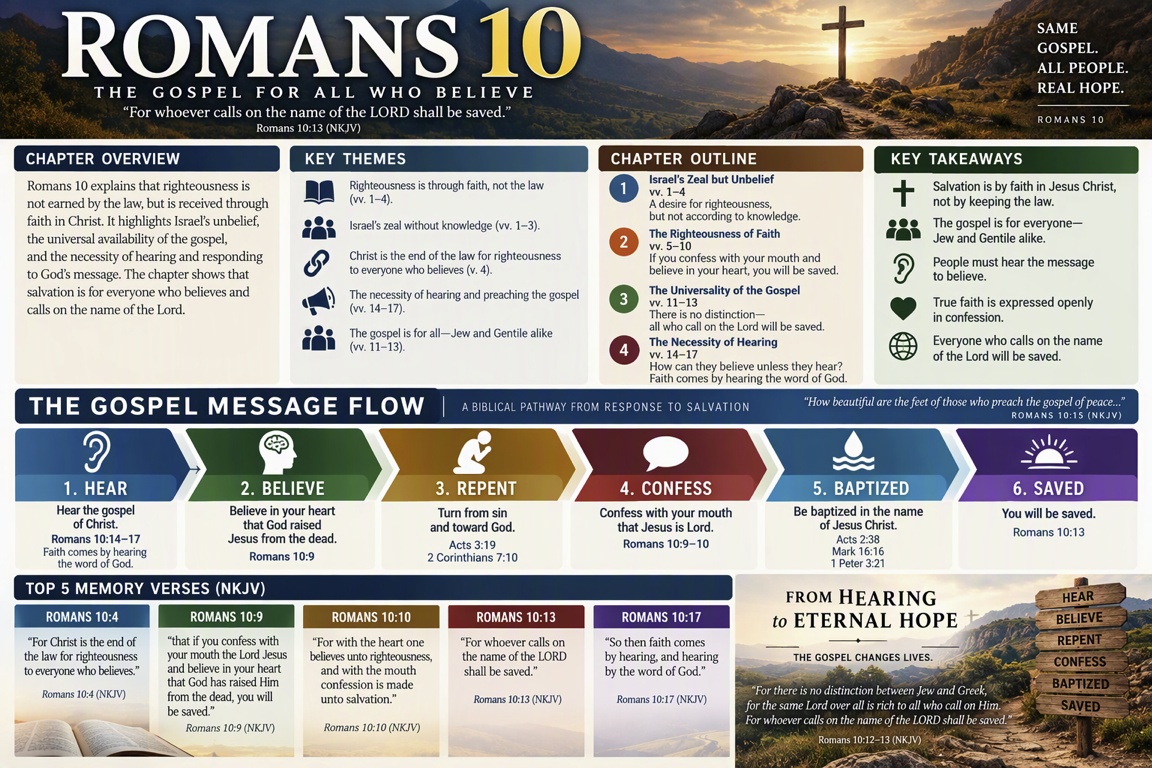
- Salvation requires a complete response to the gospel: hearing the word/truth, believing, repenting, confessing Jesus as Lord, and being baptized.
- Cherry-picking isolated verses (e.g., Romans 10:9, 10:10, 10:13, or 10:17) without reading the entire Epistle leads to false doctrines that exclude essential commands like baptism and ongoing obedience.
- Key Passages Highlighted in Romans 10
- Romans 10:4: Christ is the end of the law for righteousness.
- Romans 10:9–10: Confessing with the mouth that Jesus is Lord and believing in the heart that God raised Him from the dead results in righteousness and salvation.
- Romans 10:13: Whoever calls on the name of the Lord will be saved.
- Romans 10:17: Faith comes by hearing, and hearing by the word of God.
2. Romans 11: God's Faithfulness, Elijah, and the Remnant of Grace
- Paul’s Lineage and God's Covenant Faithfulness
- Paul rejects the claim that God has cast away His people, citing his own background as an Israelite of the seed of Abraham and the tribe of Benjamin.
- God has not rejected those He foreknew; individuals separate themselves from God when they reject His word and disobey the gospel.
- Elijah’s Wavering and the 7,000
- When Elijah fled in fear and believed he was the only faithful prophet remaining, God corrected him by revealing He had reserved 7,000 men who had not bowed the knee to Baal.
- The Remnant According to the Election of Grace
- Paul parallels Elijah's time to the present: a remnant of Israel remains saved through the election of grace.
- Grace and works are mutually exclusive: if salvation is by grace, it is no longer of works; otherwise, grace is no longer grace.
- The elect attain salvation through faith in Christ, while those relying on the law remain blinded in a spirit of stupor.
3. The Olive Tree Metaphor: Grafting, Humility, and Restoration
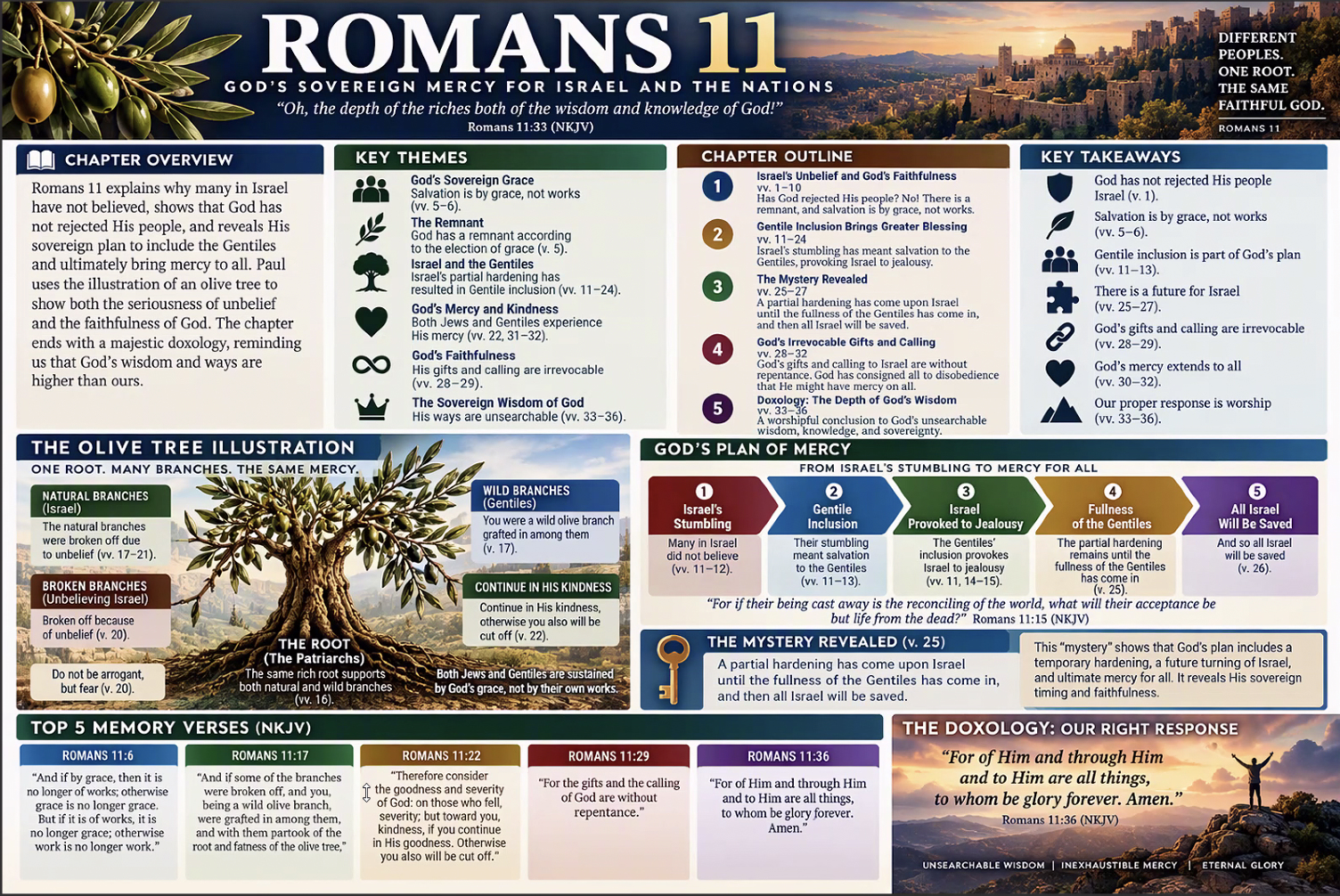
- Natural Branches Broken Off and Wild Branches Grafted In
- Unbelieving Israelites were broken off like natural branches because of unbelief.
- Gentiles, representing a wild olive tree, were grafted in among them to partake of the root and fatness of the olive tree (God's spiritual promises and blessings).
- The Parable of the Wedding Feast and Provoking Jealousy
- Similar to the invited guests refusing the wedding feast, Israel's stumbling opened the invitation to "whosoever will" among the Gentiles.
- Paul uses his ministry to the Gentiles to provoke Israel to jealousy, hoping some may turn to faith, obey the gospel, and be saved.
- Humility and Warning Against Boasting
- Gentiles must not boast against the broken branches; the branches do not support the root, but the root supports the branches.
- Salvation is entirely about God’s mercy through the death, burial, and resurrection of Jesus Christ.
- Rejection of "Once Saved, Always Saved" and Conditional Security
- Grafting is contingent upon continuing in God's kindness, word, and will; believers are warned that if God did not spare the natural branches, He might not spare them either if they fall into unbelief.
- Discarding a "set it and forget it" mentality, Scripture demands enduring faithfulness until death.
- Restoration of Israel
- If Jewish people turn from unbelief and obey the gospel of Jesus Christ, God is fully able to graft them back into their own olive tree, resulting in "life from the dead."
4. Historical, Cultural, and Contemporary Perspectives
- Bigotry, Entitlement, and Compassion
- Discussion examined the historical tension of Jewish entitlement based on ancestry versus the need for compassion, acknowledging centuries of traditions and false messianic claimants that contributed to their spiritual confusion.
- Paul’s Unique Apostleship
- Having once held a rigid legalistic mindset, Paul was uniquely equipped to preach to both Jews and Gentiles, navigating early church conflicts over circumcision and Mosaic Law (e.g., Acts 15).
- Commentary on Historical Names and Modern Conflict
- The instructor discussed the historical application of the name "Palestine" by the Romans following Jewish revolts to erase Jewish identity, contrasting it with ancient Canaanite groups (Hittites, Jebusites).
- Addressed contemporary Middle Eastern dynamics, noting that true reconciliation and lasting peace can only occur when individuals, Jew or Gentile, turn to Christ.
5. Class Logistics and Next Steps
- Visual Aids and Distribution
- The instructor shared a visual graphic of the olive tree metaphor and plans to present more detailed diagrams in the following session.
- Study materials for Romans 1–9 have been uploaded to "Barry’s bureau," and remaining graphics will be added for class access.
- Acknowledgments and Continuation
- Participants (including Don, John, Brother Johnson, Brother Pinkerton, Barry, and Betty) acknowledged the lesson, and the study of Romans will resume next week.
Assignments
-
- Memorize and recite the five key verses from Romans 10 (Romans 10:4, 10:9, 10:10, 10:13, and 10:17).
-
- Study Romans 11 in its entirety, paying specific attention to the "election of grace," the distinction between faith and law, and the olive tree metaphor.
-
- Access "Barry’s bureau" to download the Romans 1–9 study graphics and review the newly shared tree illustration.
-
- Compare Old Testament prophecies concerning the Messiah with their New Testament fulfillment at the cross to understand why Israel stumbled over Christ.
-
- Research early church debates regarding circumcision and the law of Moses in Acts 15 and Galatians, summarizing how apostolic leadership resolved them.
-
- Reflect personally on the five-part response to the gospel (hearing, believing, repenting, confessing, and baptism) and write a short journal entry on maintaining humility and enduring faithfulness before God.
-
- Prepare for next week’s session by reading the olive tree passages in Romans alongside selected texts in Hebrews regarding God speaking through His Son.