
July 2026
Bible Study: Romans Chapter 2
Instructor: Jon Pinkerton
Summary
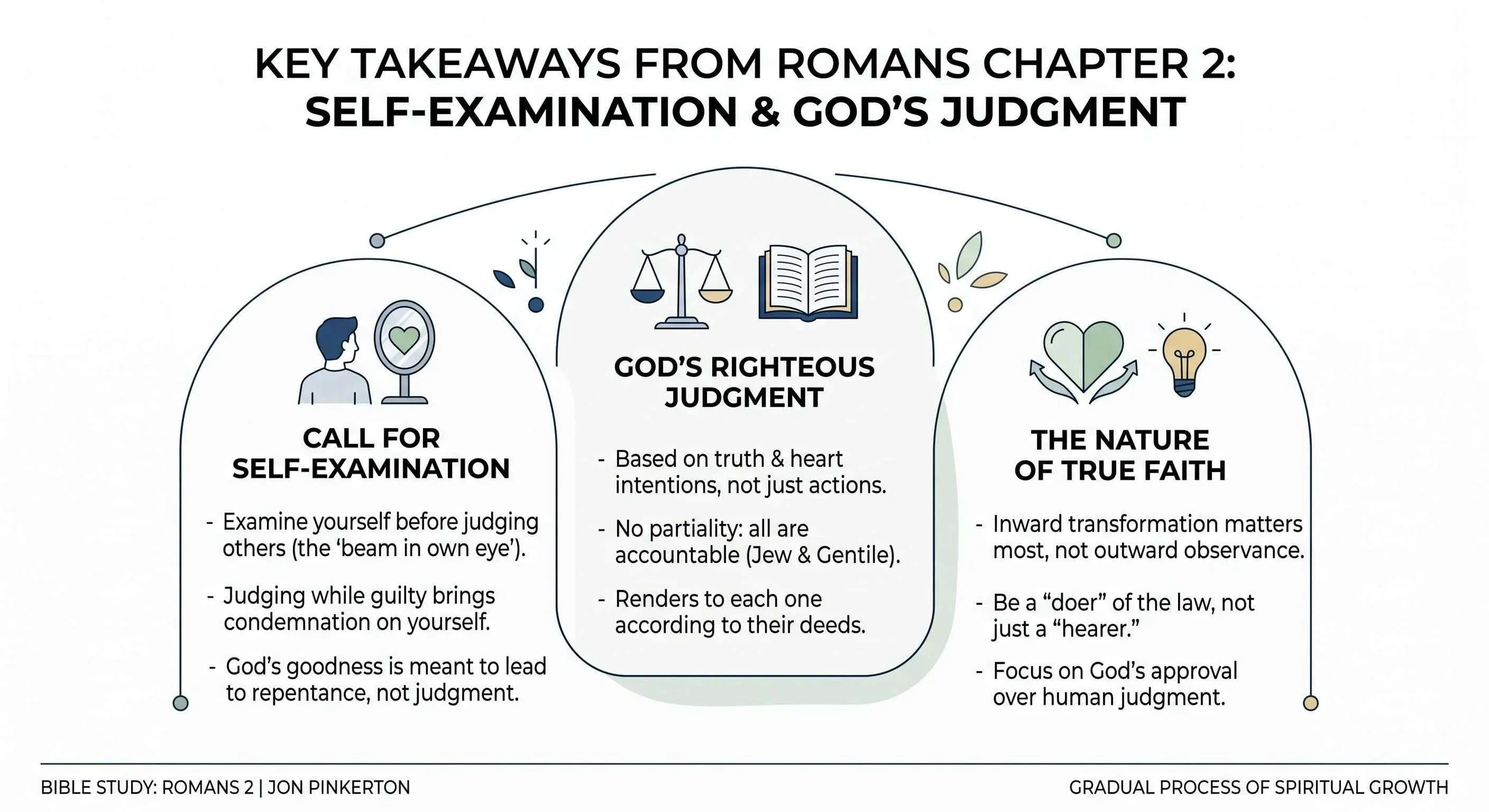
In this lecture, Jon Pinkerton provides a detailed study of Romans Chapter 2, building upon the themes of Chapter 1. The central message is a call for self-examination before judging others, emphasizing that all individuals—regardless of background (Jew or Gentile)—are accountable to God. The lecture stresses that God judges the "secrets of men" and the intentions of the heart, not just outward actions or appearances. It discusses the folly of condemning others for sins we may also be guilty of, which only accumulates wrath for ourselves. Key concepts include God's impartiality, the importance of being a "doer" of the law rather than just a "hearer," and the idea that God's goodness and longsuffering are meant to lead everyone to repentance. The second portion of the session focuses on living a life that honors God both inwardly and outwardly, ensuring one's actions align with one's faith. The discussion explores how true Christian identity is a matter of the heart, not merely outward observances. A significant portion addresses how to handle disagreements within the Christian community, emphasizing the necessity of building strong, loving relationships before attempting correction. The lecture concludes by stressing that personal transformation is a gradual process of becoming more Christ-like through study, prayer, and fellowship. ---
Knowledge Points
1. The Call for Self-Examination and Against Judgment
- Principle of Non-Judgment
- Romans 2:1 states that those who judge others are inexcusable and condemn themselves, especially if they are guilty of the same actions.
- This connects to Jesus's teaching in the Sermon on the Mount: "judge ye not, lest ye be judged," and the analogy of having a beam in one's own eye while trying to remove a speck from a brother's eye.
- The Parable of the Prodigal Son as an Example
- The older brother is used as an example of someone who judged the younger brother's sins, potentially highlighting his own hypocrisy.
- The Consequence of Judging
- By judging others with a hard and unrepentant heart, one is "treasuring up for yourself wrath in the day of wrath and revelation of the righteous judgment of God."
- The instructor personally practices not setting rigid standards for other Christians to avoid falling into self-inflicted judgment.
- Human Nature and Outward Appearances
- It is human nature to make judgments based on outward appearances rather than what is in the heart.
- The instructor shares a personal anecdote about visitors attending church on a casual day, admitting his mind immediately went to how the congregation appeared, even though this thinking was not entirely correct.
- Practicing What You Preach
- Paul questions those who teach the law but do not follow it themselves, posing rhetorical questions: "Do you preach that a man should not steal, and do you steal?" and "Do you say, 'Do not commit adultery,' do you commit adultery?"
- The core idea is whether one's actions align with professed beliefs.
- Impact of Christians' Actions on God's Reputation
- The verse "For the name of God is blasphemed among the Gentiles because of you" prompts self-examination: Are our actions outside of church causing us to dishonor God?
- Christians are often seen in public as "students of the Bible." Failing to live according to God's word can bring shame and cause others to speak blasphemously about God.
2. God's Righteous and Impartial Judgment
- God as the Ultimate Judge
- God's judgment is according to truth. Since God will judge all things, including the secrets of people's hearts, believers should spend their time lifting up, teaching, and guiding people rather than condemning them.
- God will "render to each one according to his deeds."
- God's Impartiality
- There is "no partiality in God." Judgment and salvation apply to everyone, "to the Jew first and also of the Greek" (Gentile).
- God is the God of all people, both Christians and non-Christians, whether they acknowledge Him or not.
- Two Categories of Judgment
- Those who have sinned without the law (the gospel) will perish without the law.
- Those who have sinned within the law will be judged by the law.
- Being outside the protection of God is described as a terrifying state.
- Doers vs. Hearers of the Law
- "Not the hearers of the law are just in the sight of God, but the doers of the law will be justified."
- True justification comes from acting on God's word, not merely knowing it.
3. The Nature of True Faith
- Inward Faith vs. Outward Signs
- Circumcision is used as an example of an outward sign that is profitable only if the law is kept. If the law is broken, the sign becomes meaningless.
- "He is a Jew who is one inwardly, and circumcision is that of the heart, in the spirit, not in the letter."
- Applied to Christianity: a person is a true Christian inwardly if their heart is in Christ and they are living and working for Christ.
- Focus on God's Approval over Human Judgment
- The praise that matters comes from God, not from men. It is more important to live for God and measure oneself against His Word than to perform for others.
- The Process of Spiritual Growth
- Becoming Christ-like is a gradual process, not an overnight change after obeying the gospel.
- Growth occurs through association with other believers, studying the Word, worshiping, praying, and allowing the Spirit of God to guide and teach—described as "sharpening" believers day by day.
4. Repentance, Salvation, and Christian Conduct
- God's Goodness Leads to Repentance
- We should not despise the "riches of His goodness, forbearance, and longsuffering," as these qualities allow us the opportunity to repent.
- Patient Continuance in Doing Good
- Achieving eternal life requires "patient continuance in doing good," implying a journey with expected challenges.
- Believers must remain in Christ, live according to the gospel, and patiently seek to serve God according to truth.
- The Identity of the Church in Rome
- The letter to the Romans was written to the saints in Rome, including both Jews and Gentiles. At the time, many Jews had been expelled from Rome, making the church largely Gentile.
- The message addressed potential feelings of superiority from Jewish Christians and reminded everyone they are one in Christ after obeying the gospel.
- Mentoring and Correcting with Love
- When new or young believers dress or behave inappropriately for worship, the key is to teach with love to win souls, not drive them away.
- A practical example: instead of blaming, an older sister asked a young lady, "Who did you dress for?" This shifted the focus to dressing for God rather than to impress others.
- All conduct, including dress and demeanor, should be done with the mindset of presenting oneself before God.
5. Handling Disagreements Within the Church
- The Prerequisite of Relationship Before Correction
- When disagreements arise between believers (e.g., over celebrating Christmas), the first step is to build a strong, loving relationship.
- An analogy: you can speak frankly to your biological sister because of your established relationship. The same level of relationship should be sought with brothers and sisters in Christ.
- If a strong relationship doesn't exist, it may be better for a church leader to address the situation.
- Focusing on Love and Understanding
- The core question is whether actions are done in love: "Is everything we're doing in love when we do it to one another?"
- The primary goal should be to seek understanding and build relationships, not to criticize or judge.
- Distinguishing Essential from Non-Essential Issues
- The example of Christmas trees illustrates issues that can cause division but are not central to faith.
- Romans Chapter 14 addresses matters of Christian liberty—such as what to eat or how to observe days—which are not things to argue over, as long as one is doing what God has commanded. These are often distractions used to cause division.
Assignments
-
- Practice self-examination before seeking to find fault in others to avoid bringing judgment upon oneself.
-
- Focus on lifting up, teaching, and guiding people within the will of God rather than judging or condemning them.
-
- When approaching a fellow believer about their conduct (e.g., dress), do so with love and a focus on teaching them to honor God, aiming to win their soul rather than alienate them.
-
- Strive to be a "doer" of the word, not just a "hearer," by actively living according to the gospel.
-
- Cultivate a mindset that all actions, especially during worship, are done to present oneself before God—not for the approval of other people.
-
- Read Romans Chapter 14 to better understand Christian liberty and how to handle disagreements on non-essential matters.
-
- Engage in self-examination to ensure personal actions align with professed faith and honor God in all settings, inside and outside of church.
-
- Prioritize building strong, loving relationships with fellow church members before attempting to correct or criticize them.
-
- Continue the study next week, beginning with Romans Chapter 3.